Ok, so after watching this video:
I'm re-inspired, and I realize that I can't just go from never designing a pinball in my life, to the level that Stern is at. I should know better being an engineer, and realize how a design has to go through iterations, and learning from your mistakes. I need to start out small, simple, baby steps. Here's my goal and iteration list:
Version 1.0 - completely mechanical, no electric at this point. I want to be able to layout a full pinball, with foam board, and have everything powered by motion (of which I have a ton of great ideas to incorporate modern things like multiball).
Version 2.0 - Add LED general illumination, rollover lights, and mp3 sound using a 5V arduino board. This can run off of 4 D batteries, or a 5v wall plug.
Version 3.0 - Add a scoring system (using Arduino counter code), add an Arduino driven 7-segment display for output)
Version 4.0 - Update to 14-segment display like on late 80's williams pins (earthshaker, funhouse), add animations
Version 5.0 - Impliment a 12V system to power DC actuator driven flippers, pop bumpers, drop targets, etc. Run off of rechargable AGM (small sealed car battery). Use DC to DC converter to drop 12v down to 5v to continue running arduino system.
My intention of this project is multi-fold.
1. I REALLY want to design a pinball, from scratch, while innovating new features that have never been seen before
2. It would be nice if this takes off, to actually sell a small run of them.
3. Offer something the pinball community has never seen before. I want to make something simple, affordable, light, and easy to work on (because it will be dead simple). Ideally, I want to make it possible to stack playfields, and just have cabinet stands (that don't move), and then swap them out to keep things rotated (without having to trade, or sell/buy all the time). I hear all the time about people living in small spaces in europe, people stuck in small apartments. If I can offer a way for those people to own pinballs, at affordable prices (and not take up a ton of space, or be able to stow it away), I've hit an all new market. Also on top of being affordable and lightweight (cheaper shipping), being powered by low voltage and power, it's completely possible to charge up batteries with solar power and have pinball in 3rd world nations (if this business really takes off, I'm totally going to donate a couple to random nations).
I've already come up with a mission statement, a logo, and designed my first mechanism in solidworks this morning. I don't want to reveal anything until I have a few more mechanisms designed out, and I have my first foam prototype built, but I'm really excited to getting this going.

Wednesday, May 9, 2012

Wednesday, April 18, 2012
You gotta have the right tools for the job, Beavis!
http://bubblare.se/movie/beavis_and_butthead_pool_toys_
I've decided that rather than having tools sprawled throughout the basement (which is supposed to be getting cleaned up), I need to figure out exactly what I need specifically for pinball. Clay (who is a pinrepair god in our world) has made many tips pages, and videos going through his own repairs, and a couple months ago I ran across this video where he basically takes apart his briefcase of tools and shows you everything he needs to work on any pinball from any generation:
I want to take what I have, figure out what I need, and just create a giant list of stuff. Then take all that stuff, and somehow dump it into a rolling cart (like an auto mechanic might have), and there'd be drawers, and bins, and platforms sliding out revealing things like soldering irons, and giant light bars, and a retractable cord where I can plug it into a power strip lined on my basement ceiling rafters.
So from the video above (which goes by very quickly in 5 minutes), this is my list. x means I have the part, * means I have part of the item, or I have it but I want something better, and - means I need to buy it:
* powerstrip attached to a rafter & vertical stud
http://www.amazon.com/Tripp-Lite-PS4816-16-Outlet-15-Foot/dp/B000051174/ref=sr_1_4?s=hi&ie=UTF8&qid=1334804207&sr=1-4
* soldering iron holder on a cart with tools (rod for solder spool)
- needlenose pliers
- flushcutter
- PLC square asic (ROM puller)
- radio shack infared detector
x lightbulb remover
x assortment of nut drivers
x 1/4 magnetic nut driver
x universal screwdriver
- allen wrench set (american and metric), get T-set
x wire crimpers
- blades (metal and plastic)
- emery board
- vise grip channel locks
x Novus 1/2/3
- sharpie
- knockout punches (knockout pins)
- wirebrush
x desolderer
- maglight (lightbar)
- electric screwdriver (low profile)
- lighter fluid (clean rubber and grease)
- that red cleaner bottle (krazy clean)
x tiny peen hammer
- 3-in-1 oil
x tyco circuit breaker devices (like on trimmer, snag some), troubleshoot GI shorts
x DMM (digital multi-meter)
- assortment of heatshrink tubing
x assortment of nylon ties
* assortment of nuts + bolts (6-32, 8-32, 10-32, 10-24), started to get these
- assortment of E and C clips
- assortment of coil sleeves
- assortment of fuse clips
- assortment of bulb holders
- xacto set
- electrical tape
- two sizes adjustable wrenches
- fixed open end wrenches for bolts
- 91% alcohol
- sandpaper grits (320-400-600-800) cleaning steppers
x alligator clips
* level
- crafstman tapper (taps fit inside body)
- security bit sets
- general wiring (14AWG??)
- teflon gel lube?
parts:
bulbs (various)
fuses
diodes
extra balls
spare molex pins/connectors, pins removers
I've decided that rather than having tools sprawled throughout the basement (which is supposed to be getting cleaned up), I need to figure out exactly what I need specifically for pinball. Clay (who is a pinrepair god in our world) has made many tips pages, and videos going through his own repairs, and a couple months ago I ran across this video where he basically takes apart his briefcase of tools and shows you everything he needs to work on any pinball from any generation:
I want to take what I have, figure out what I need, and just create a giant list of stuff. Then take all that stuff, and somehow dump it into a rolling cart (like an auto mechanic might have), and there'd be drawers, and bins, and platforms sliding out revealing things like soldering irons, and giant light bars, and a retractable cord where I can plug it into a power strip lined on my basement ceiling rafters.
So from the video above (which goes by very quickly in 5 minutes), this is my list. x means I have the part, * means I have part of the item, or I have it but I want something better, and - means I need to buy it:
* powerstrip attached to a rafter & vertical stud
http://www.amazon.com/Tripp-Lite-PS4816-16-Outlet-15-Foot/dp/B000051174/ref=sr_1_4?s=hi&ie=UTF8&qid=1334804207&sr=1-4
* soldering iron holder on a cart with tools (rod for solder spool)
- needlenose pliers
- flushcutter
- PLC square asic (ROM puller)
- radio shack infared detector
x lightbulb remover
x assortment of nut drivers
x 1/4 magnetic nut driver
x universal screwdriver
- allen wrench set (american and metric), get T-set
x wire crimpers
- blades (metal and plastic)
- emery board
- vise grip channel locks
x Novus 1/2/3
- sharpie
- knockout punches (knockout pins)
- wirebrush
x desolderer
- maglight (lightbar)
- electric screwdriver (low profile)
- lighter fluid (clean rubber and grease)
- that red cleaner bottle (krazy clean)
x tiny peen hammer
- 3-in-1 oil
x tyco circuit breaker devices (like on trimmer, snag some), troubleshoot GI shorts
x DMM (digital multi-meter)
- assortment of heatshrink tubing
x assortment of nylon ties
* assortment of nuts + bolts (6-32, 8-32, 10-32, 10-24), started to get these
- assortment of E and C clips
- assortment of coil sleeves
- assortment of fuse clips
- assortment of bulb holders
- xacto set
- electrical tape
- two sizes adjustable wrenches
- fixed open end wrenches for bolts
- 91% alcohol
- sandpaper grits (320-400-600-800) cleaning steppers
x alligator clips
* level
- crafstman tapper (taps fit inside body)
- security bit sets
- general wiring (14AWG??)
- teflon gel lube?
parts:
bulbs (various)
fuses
diodes
extra balls
spare molex pins/connectors, pins removers
Wednesday, April 4, 2012
pinball needs a reboot
For some reason the floodgates of ideas came to me this morning. There's something about the pinball industry that's been bugging me lately. You have Stern who's been sitting on their throne for the last 12 or so years, letting quality and innovation slide more and more (while hiring more and more talent so they can crank out 3 pins every year). Slowly the masses have been getting fed up, some by voting with their wallets, some by starting their own companies. You have a small startup in spain (marsaplay) which has done some REALLY innovative things (LCD screen, like jersey jack has also implimented), you have PCB's underneath the playfield replacing expensive wiring (both in materials and labor), you have magnet switches instead of mechanical (no holes for dirt to get into, no moving parts). For a company out of spain, pretty damned impressive (even if they're first pin is a remake from the late 70's). Then you have jersey jack, taking 2 years to build up parts, design a layout, get a production area setup, really not too bad. Then you have Jpop teaming up with ben heck to work on pinballs (ben heck is a genius, his only negative attribute is he likes to finish a project in a week and move onto the next one). Jpop seems to be balancing him out, doing things right (eliminating ball lock, laying out clean and fun layouts).
So here's why it needs a reboot. All this new competition is all fun and good (hopefully Stern realizes they can't produce crap anymore), but there's still something lacking. Pinball, honestly, hasn't changed a whole heck of a lot since the mid 80's (other than DMD displays). Honestly, it hasn't changed hardly at all since the early 90's (I think it's gone downhill). You still have a custom CPU processor, you still have a driver board, you still have a sound board, you still have a giant (and HEAVY) linear transformer at the bottom of the cabinet, you still have a backbox with lights behind it, you still have miles of copper wire bundled up like kindling with similiar colored jackets, and it's so hard to trace where any wires go, or if those connections are any good (everything is still hand soldered). I also think a lot of people don't get into the hobby because they can't afford to pay a tech to fix it ($75 travel + $75/hour labor), and you thought the auto mechanic was taking a bath on you?
Cost reduction / simplify #1: Every pin is hours and hours of labor, really if you look at pinball machines they are the rolls royce of consumer product. Each one is hand built. Imagine if PC's were still through hole and hand soldered, we would still be paying $2,000 for a computer, but we don't. Know why? Some guy lays out a PCB in software, those boards are printed with silkscreen in layers, and the surface mount components are wave soldered (cheap cheap). That's why you can buy a motherboard for $30. Imagine applying that to pinball? Run all your traces through PCB (including high voltage). yes it can be done, you only need thick wires for high amps, not volts. If you took a playfield, and split it up into sub-assembly PCB's, and just had ribbon cables for data and power, you could clearly label (in plain etched text) what each trace is, where it's going, etc. If a pcb is having issues, replace it... or repair it, or send it out for repair (just like marsaplay canasta):
http://www.pinballnews.com/games/newcanasta
 This also means much easier plug n play (playfield swaps would be a cinch!). Connectors have locking tab (no more solder joints getting cold). Makes labor to build a pin dirt cheap (couple dozen standoffs, connect some pre-made wires). You would have much better diagnosis because the cpu could pinpoint which section is having issues (which would be labeled), and then you could focus your attention on that one part (instead of treating it as a whole).
Cost reduction / simplify #2:One common platform. This probably isn't an issue 2 years ago (Stern is the only one, buy Stern cpu, Stern power supply, Stern driver board). Now that competition is back, it's back to having a bunch of platforms (each their own cpu, driverboard, soundboard, power supply, pop bumper design, flipper design, ball trough design, drop target design, etc etc). I'm talking about making pinballs like the auto industry is attempting to do. It used to be every auto company designed their own parts, right down to the dam door locks. Toyota and Suburu are sharing engines, many interior components are shared across manufacturers, companies are sharing hybrid technologies. Why? they were forced to. It's a global economy, and the only way for multiple car companies to survive is by teaming up, and sharing the design workload. This saves time and money (more parts, more volume, lower cost). Pinball needs to do the same thing. We need a single STANDARDIZED platform, perhaps open sourced, by which all pinballs are created. New CPU's can be designed (revisions), but would be backwards compatible with older pins. This would lower the cost of parts, would lessen product development (more familiar if you only have to deal with one system), and mean easier to replace (and diagnose). If I can pull a board from another pin to test with, it makes it easier to figure out what's wrong. In my collection, I have a data east (it's own hardware), and two williams (one is a system 11, one is a system 9), all 3 incompatible with each other.
So here's my grand scheme overall picture idea. The market is slowly shifting from arcades to homes.. it's just a fact. Pins in public are rare (occasional bowling alley, maybe a pizza joint, a gameworks if your in a major city). If your really lucky, someone has decided to fix up an older pin and route it in a bar (and keep it maintained). For the most part, I believe Stern's biggest customer are home buyers. Even though the buying market has skewed and changed, the pin has not. They still build them as if they are going on route (locked doors, coin boxes, etc). Here is what I sketched up today:
 Basically you would have a base (generic) cabinet. You would have your standardized common CPU, power, driverboard, soundboard, sound amplifier, speakers. Then an LCD screen replaces the backbox. I know people will complain about not being pure, but we're talking about revolutionizing pinball here. LCD's (HD at least) are really good these days. they talk about retina resolution (so many pixels per inch, it looks like paper). If you put that behind glass, Can you honestly tell me you can notice the difference while playing? Some people say things like "yea, but when they're off, you have a black screen". If this is really an issue, maybe in 2-3 years e-ink displays this size will be comparably priced, and the energy to run them will be zero (e-ink only uses power when the display changes). Now, the only thing you swap out is the populated playfield. That's right, you keep the same cabinet, swap out a rom chip (which would be like a cartridge, not EEPROM.. think robust like a nintendo cartridge). Arcades started doing this with cabinets to reduce operator cost. They'd have mortal kombat, MKII comes out, they add a button, swap out the CPU inside, and voila! MKII for cheap! There is NO reason pinball couldn't do this same thing! "Oh but what about the cabinet artwork?!" people will say as they raise their torches. Two things:
1. If you have a big collection, your pins are stacked right against the other one, and you don't even get to see the side artwork (hence why toppers are gaining popularity).
2. Artwork gets scratched up during shipment.
My suggestion (if you really must have artwork) is have a plexiglass sleeve on the side where you can slip new artwork into. This means artwork is never tied to a cabinet.
Another bonus of a system like this: Saves space. Yea, believe it or not, the whole world doesn't live like most americans (1600+ sq feet of space), not everyone can live in the burbs. If I live in the city, most likely I will live in less than 1,000 sq feet. Unless I rent an expensive warehouse of some sort, I have no place to put my pins. If I had a system like this, I could have one cabinet, and probably 3-4 populated playfields in storage. You look at places like japan, UK, netherlands, they all live in small spaces too
Do I think this will replace the traditional cabinet? No, people still drive rolls royces. People still buy $200k ferrari's that are handbuilt by a pair of technicians that dyno an engine and mate it with a hand picked transmission. Most people buy a mass produced car, a car that is made on an assembly line, cranked out in mass quantities, and with good quality and nice features. The world needs a toyota pinball company.
So here's why it needs a reboot. All this new competition is all fun and good (hopefully Stern realizes they can't produce crap anymore), but there's still something lacking. Pinball, honestly, hasn't changed a whole heck of a lot since the mid 80's (other than DMD displays). Honestly, it hasn't changed hardly at all since the early 90's (I think it's gone downhill). You still have a custom CPU processor, you still have a driver board, you still have a sound board, you still have a giant (and HEAVY) linear transformer at the bottom of the cabinet, you still have a backbox with lights behind it, you still have miles of copper wire bundled up like kindling with similiar colored jackets, and it's so hard to trace where any wires go, or if those connections are any good (everything is still hand soldered). I also think a lot of people don't get into the hobby because they can't afford to pay a tech to fix it ($75 travel + $75/hour labor), and you thought the auto mechanic was taking a bath on you?
Cost reduction / simplify #1: Every pin is hours and hours of labor, really if you look at pinball machines they are the rolls royce of consumer product. Each one is hand built. Imagine if PC's were still through hole and hand soldered, we would still be paying $2,000 for a computer, but we don't. Know why? Some guy lays out a PCB in software, those boards are printed with silkscreen in layers, and the surface mount components are wave soldered (cheap cheap). That's why you can buy a motherboard for $30. Imagine applying that to pinball? Run all your traces through PCB (including high voltage). yes it can be done, you only need thick wires for high amps, not volts. If you took a playfield, and split it up into sub-assembly PCB's, and just had ribbon cables for data and power, you could clearly label (in plain etched text) what each trace is, where it's going, etc. If a pcb is having issues, replace it... or repair it, or send it out for repair (just like marsaplay canasta):
http://www.pinballnews.com/games/newcanasta
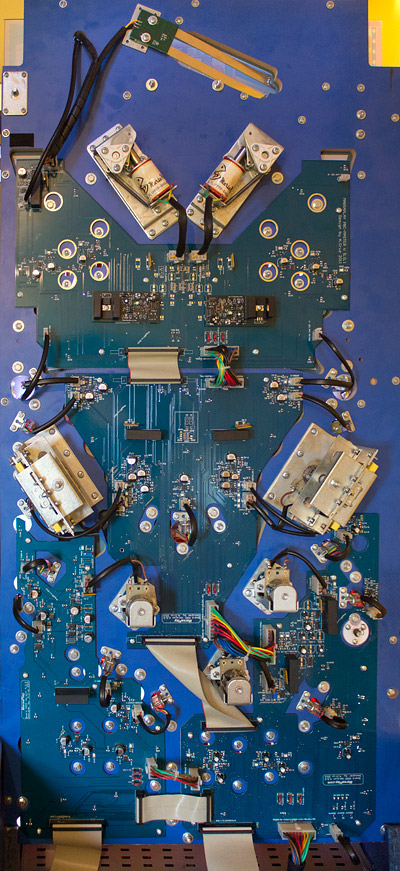
Cost reduction / simplify #2:One common platform. This probably isn't an issue 2 years ago (Stern is the only one, buy Stern cpu, Stern power supply, Stern driver board). Now that competition is back, it's back to having a bunch of platforms (each their own cpu, driverboard, soundboard, power supply, pop bumper design, flipper design, ball trough design, drop target design, etc etc). I'm talking about making pinballs like the auto industry is attempting to do. It used to be every auto company designed their own parts, right down to the dam door locks. Toyota and Suburu are sharing engines, many interior components are shared across manufacturers, companies are sharing hybrid technologies. Why? they were forced to. It's a global economy, and the only way for multiple car companies to survive is by teaming up, and sharing the design workload. This saves time and money (more parts, more volume, lower cost). Pinball needs to do the same thing. We need a single STANDARDIZED platform, perhaps open sourced, by which all pinballs are created. New CPU's can be designed (revisions), but would be backwards compatible with older pins. This would lower the cost of parts, would lessen product development (more familiar if you only have to deal with one system), and mean easier to replace (and diagnose). If I can pull a board from another pin to test with, it makes it easier to figure out what's wrong. In my collection, I have a data east (it's own hardware), and two williams (one is a system 11, one is a system 9), all 3 incompatible with each other.
So here's my grand scheme overall picture idea. The market is slowly shifting from arcades to homes.. it's just a fact. Pins in public are rare (occasional bowling alley, maybe a pizza joint, a gameworks if your in a major city). If your really lucky, someone has decided to fix up an older pin and route it in a bar (and keep it maintained). For the most part, I believe Stern's biggest customer are home buyers. Even though the buying market has skewed and changed, the pin has not. They still build them as if they are going on route (locked doors, coin boxes, etc). Here is what I sketched up today:

1. If you have a big collection, your pins are stacked right against the other one, and you don't even get to see the side artwork (hence why toppers are gaining popularity).
2. Artwork gets scratched up during shipment.
My suggestion (if you really must have artwork) is have a plexiglass sleeve on the side where you can slip new artwork into. This means artwork is never tied to a cabinet.
Another bonus of a system like this: Saves space. Yea, believe it or not, the whole world doesn't live like most americans (1600+ sq feet of space), not everyone can live in the burbs. If I live in the city, most likely I will live in less than 1,000 sq feet. Unless I rent an expensive warehouse of some sort, I have no place to put my pins. If I had a system like this, I could have one cabinet, and probably 3-4 populated playfields in storage. You look at places like japan, UK, netherlands, they all live in small spaces too
Do I think this will replace the traditional cabinet? No, people still drive rolls royces. People still buy $200k ferrari's that are handbuilt by a pair of technicians that dyno an engine and mate it with a hand picked transmission. Most people buy a mass produced car, a car that is made on an assembly line, cranked out in mass quantities, and with good quality and nice features. The world needs a toyota pinball company.
Wednesday, March 21, 2012
MGC

Sort of excited to be going this saturday. Was thinking about going friday night too, but putting my dogs in a hotel, and myself in a hotel, for what.. 4-5 hours playing a tournament? I figure a full saturday is more than enough time to play a bunch of games, visit some vendors, and call it a day. I may go multiple days when the chicago expo comes around. This is actually my first time going to this, though seeing videos of prior shows I sort of have an idea what I'm in for.
http://www.midwestgamingclassic.com
Sunday, March 11, 2012
3 pins in the house
Just picked up my lethal weapon pin yesterday, beautiful condition. Got it from a guy that buys and sells pins, video games, jukeboxes (it's his living). Lives on a retired farm, works out of his garage. It's nice to finally buy a pin, and have nothing that needs to be repaired. Just plug it in, and away you go with playing it. The lineup is looking pretty nice.


Tuesday, February 28, 2012
gator is sold!
Just went out the door about 2 hours ago. I find it odd I couldn't get rid of it for $200 just 3 months ago. I list it now at the same price, I have people begging to buy it at that price. Actually ended up getting a buyer that offered $250 for it, so with parts I at least broke even (possibly profited). Odd story to that, I get an email from one guy, says he's emailing me in advance to make sure it's not sold yet, but the guy who's buying it can't email from work (blocked from craigslist). Then I get an email from the buyer later on.. From Lincoln nebraska! I'm like "woah man, that's a haul, you sure about this?". Turns out he's friends with a pinball repair guy up in Racine, WI.. I guess he pays this guy to snatch up pinballs in the area, and 2-3 times a year he hauls them down in a trailer (he has family in NE). Tells me this guy has only been in the hobby about 3 years, already has like 300 pinballs in his collection (that's a pin every 4 days!) I not only don't fathom how you afford that, but where the hell do you store a collection like that?
Oh how it seems like just yesterday I bought it:
http://homebrewpinball.blogspot.com/2011/05/my-first-pinball-machine.html
Ho-hum, time to find a replacement :-)
Oh how it seems like just yesterday I bought it:
http://homebrewpinball.blogspot.com/2011/05/my-first-pinball-machine.html
Ho-hum, time to find a replacement :-)
Saturday, February 18, 2012
space shuttle sound fixed
I haven't had sound since I bought it. My first guess was to replace the soundboard. At least by doing that, I got really faint sound (like quieter than ipod headphones). I thought maybe it was the CPU, maybe a volume adjustment pot? So I finally got around to buying a new power supply recently, knowing that it's probably not a bad idea to replace that since the one in there looked like a cap leaked (new modern replacement power supply is also more efficient and reliable). Taking the old powerboard out, I saw that there was also some black pins on the back, more proof that this thing was just not stable. Get the new board mounted in, turn it on, low and behold my machine is screaming loud. I was so happy at that moment, I had actually got something else working, and sound was half of the game. I had guests over, so I could only play a quick game. After they left, I went back down and played another 3 games.
I think my next step is figuring out why I have one section of general illlumination out. From what I've read on message boards, it's either a popped fuse (doesn't look that way), or the ground wire to that section is shorted (or possibly cut), so I'm going to prop up the playfield to see if I can find something obvious. Once I get that figured out, mechanically it should be 100% working. Then I just need to do my playfield swap and repaint the outer cabinet to make it look all pretty.
I think my next step is figuring out why I have one section of general illlumination out. From what I've read on message boards, it's either a popped fuse (doesn't look that way), or the ground wire to that section is shorted (or possibly cut), so I'm going to prop up the playfield to see if I can find something obvious. Once I get that figured out, mechanically it should be 100% working. Then I just need to do my playfield swap and repaint the outer cabinet to make it look all pretty.
Subscribe to:
Posts (Atom)